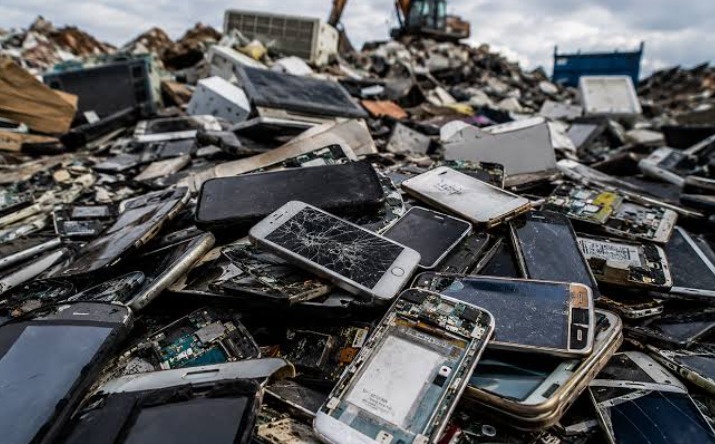
The Hidden Cost of Throwing Technology Away

The average household replaces its phone every two to three years, its laptop every four to five, and its television roughly every seven. Multiply those cycles across billions of people and the result is the fastest growing waste stream on the planet, growing several times faster than the global population and considerably faster than recycling capacity is expanding to meet it.
What makes this stream different from ordinary household waste is not the volume, which is actually modest compared to packaging or construction debris. It is the composition. A discarded appliance is a dense package of engineered materials, some of them extraordinarily valuable and some of them genuinely hazardous, compressed into a form designed for performance rather than for eventual separation.
That combination is what makes the e-waste environmental impact so disproportionate to the tonnage involved. A single tonne of discarded devices carries a heavier environmental burden and a higher recoverable value than almost any other category of waste, and the way it is handled determines which of those two facts ends up mattering.
What Leaches Out of a Landfill
Landfills are engineered to contain material, but containment degrades over decades and liners eventually fail. Devices buried today will still be releasing material long after the site has been capped and forgotten.
Lead is present in older cathode ray tube glass and in solder throughout circuit boards. It is a neurotoxin with no safe exposure threshold, and it mobilizes readily in the acidic conditions found in decomposing landfill mass.
Mercury appears in backlighting components of older flat panel displays and in some switches and relays. It is persistent, it bioaccumulates through food chains, and it converts to methylmercury in aquatic environments, which is the form that concentrates in fish and reaches people.
Cadmium, used in older rechargeable cells and some semiconductor applications, accumulates in kidney tissue over long exposure periods. Brominated flame retardants, applied to plastic housings and circuit boards, persist in the environment for decades and have been detected in human tissue samples worldwide.
Lithium batteries add an immediate rather than a delayed hazard. Compressed or punctured cells ignite, and battery-related fires in waste facilities and collection vehicles have become a serious operational problem across North America and Europe.
The Damage That Happens Before Manufacturing Begins
The disposal end of the story receives most of the attention, but the larger environmental cost sits at the extraction end. Every device represents mining, refining, and manufacturing that already happened.
Copper extraction moves enormous volumes of rock for modest metal yields and generates acid mine drainage that can affect watersheds for generations. Gold refining relies on cyanide leaching. Cobalt supply is concentrated in regions with documented labour and environmental problems. Rare earth processing produces radioactive tailings as a routine byproduct.
Manufacturing then adds its own footprint. Semiconductor fabrication is water intensive and energy intensive, and the majority of a device’s lifetime carbon emissions are typically produced before it is ever switched on. For a smartphone, manufacturing commonly accounts for around eighty percent of total lifecycle emissions.
This is why disposal decisions carry weight beyond the waste itself. Discarding a device does not just add material to a landfill. It guarantees that the extraction and manufacturing cycle has to run again to produce a replacement.
Informal Processing and Where the Harm Concentrates
A significant portion of the world’s discarded electronics ends up in informal processing operations, often after being exported under labels describing it as used equipment for resale. In these settings, recovery is done without controls: cables are burned to expose copper, boards are heated over open flames to release solder, and acid baths are used to dissolve gold from connectors.
The health consequences are documented and severe. Communities near these operations show elevated blood lead levels, respiratory illness, and adverse birth outcomes. Soil, water, and air contamination extends well beyond the immediate work areas. Children are frequently involved in the work.
The uncomfortable point is that this harm is a direct consequence of disposal decisions made thousands of kilometres away. Material follows the cheapest path available unless someone deliberately directs it somewhere else, and choosing a processor who can account for downstream handling is what breaks that chain.
The Case for Treating Devices as Material Stock
There is a more constructive way to frame all of this. Concentrations of valuable metals in discarded electronics substantially exceed concentrations in natural ore bodies. A tonne of circuit boards yields far more gold than a tonne of mined rock. Copper, aluminum, steel, and increasingly cobalt and lithium can all be recovered at scale.
Recovering these materials avoids the extraction impacts described above and consumes dramatically less energy. Recycled aluminum requires roughly five percent of the energy needed for primary production. Recovered copper avoids the mining and smelting footprint entirely.
Supply chain considerations are pushing this from an environmental argument toward an economic one. Critical mineral availability has become a strategic concern for most industrialized economies, and domestic recovery from retired equipment is one of the few supply sources that does not depend on foreign extraction.
What Actually Moves the Needle
Extending device lifespan is the single most effective intervention available to individuals. A phone kept four years instead of two halves its annualized manufacturing footprint. Repair, battery replacement, and resisting upgrade cycles driven by marketing rather than need all contribute more than any disposal decision.
When replacement is genuinely necessary, passing working equipment on keeps it in service. When a device is truly finished, routing it to a processor with verifiable downstream handling ensures the material re-enters supply chains rather than a landfill or an informal yard.
For organizations, the leverage is larger simply because the volumes are larger. Procurement decisions that favour repairable equipment, deployment policies that extend refresh cycles, and disposal contracts that require documented processing collectively make more difference than any consumer behaviour.
None of this requires new technology. The recovery capability already exists. What determines whether it gets used is a series of small routing decisions made at the moment a device stops being useful, and those decisions are entirely within reach.